Carpenter ants can damage your home if they are not stopped early.
Carpenter ants are widely distributed in the United States and can cause severe structural damage to wood in homes. If caught early, treatment can stop damage before repairs become major.
Call (775) 450-7077Carpenter Ants
Carpenter ants of the genus Camponotus are usually large and polymorphic, with worker sizes ranging from 1/4 inch to more than 3/4 inch. They may invade homes foraging for food or building nests inside wood.
The black carpenter ant, Camponotus pennsylvanicus, is common in the eastern United States and is dull black with long yellowish hairs on the abdomen. Other species include red carpenter ants, Florida carpenter ants, and western species such as C. modoc, C. laevigatus, C. hyatti, C. clarithorax, and C. vicinus.
Carpenter ants usually excavate wood softened by decay, but they may also attack sound dry wood. Galleries inside wood are smooth and sandpapered, and activity often leaves piles of fibrous bore dust in basements, closets, under porches, and other hidden places.
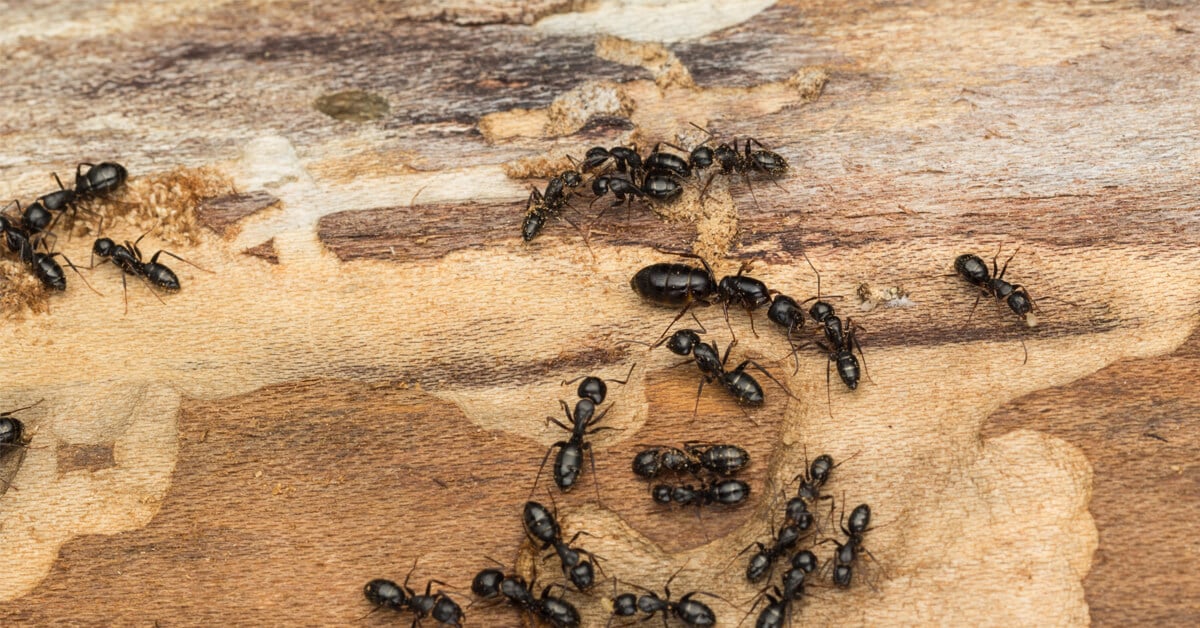
Carpenter Ants in the Home
Long-standing carpenter ant infestations can cause extensive structural damage and may require major repairs. Early detection is essential to keep treatment manageable and effective.
Carpenter ants frequently enter homes from nearby wooded areas, brush, or mulch. They may follow telephone or electric wires, crawl along branches touching a roof, or enter through foundation openings.
Colony members may forage as far as 300 feet from the nest, and the appearance of flying reproductive ants is a strong sign that the infestation is ongoing and must be controlled.
During the spring, homeowners often first notice carpenter ants when winged ants appear around windows or walls. A rustling sound in walls and piles of sawdust-like bore dust are also common indicators.
Biology and Control
Carpenter ant colonies usually begin with a single queen that nests in soil, wood, or tree cavities. Small workers feed the queen and young until the colony grows.
Carpenter ants can be difficult to control, and many pest control operators report callbacks for additional service. Professional treatment is often needed to eliminate the colony and prevent further structural damage.